

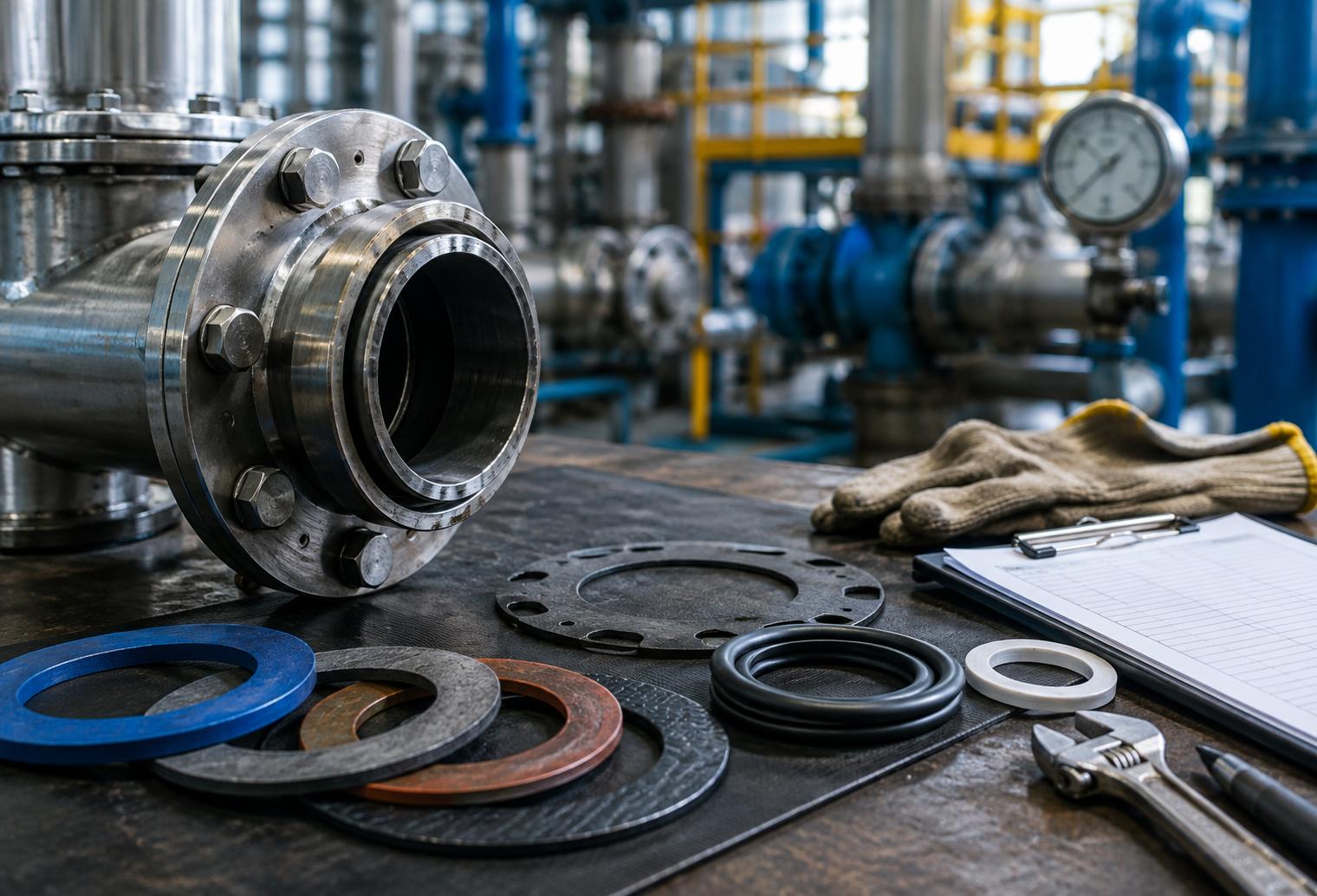
Industrial fluid leaks can create expensive problems for facilities in Durant, from lost process fluids and cleanup needs to equipment downtime and premature component wear. In southeastern Oklahoma, heat, outdoor exposure, vibration, and demanding operating schedules can place additional stress on gaskets and seals. A consistent maintenance program helps identify deterioration before a minor seep becomes a larger failure.
Quick answer: Preventing industrial fluid leaks requires routine inspection, correct gasket and seal selection, proper installation, controlled fastener loading, and timely replacement of worn components. Maintenance teams should pay particular attention to flange connections, pumps, valves, process equipment, and other locations where pressure, temperature, vibration, or chemical exposure can degrade sealing materials.
What local facilities should know
-
Small signs of seepage around a gasketed joint can indicate compression loss, material degradation, or movement that deserves inspection.
-
Durant facilities with outdoor equipment should consider the effects of Oklahoma heat, temperature swings, moisture, and weather exposure on sealing materials.
-
Industrial operations throughout Bryan County may require different gasket materials depending on the fluid, pressure, temperature, and equipment involved.
-
Repeatedly tightening a leaking joint is not always a safe or effective substitute for identifying the actual cause.
-
Custom gaskets and seals can be useful when standard components do not match the equipment dimensions, material requirements, or operating environment.
Why Does Gasket and Seal Maintenance Matter for Durant Industrial Facilities?
Gasket and seal maintenance matters because these components form critical barriers between process fluids and the surrounding workplace. For facilities in Durant and the surrounding Red River region, preventing deterioration can reduce unexpected leaks, help protect equipment, and give maintenance teams more control over when repairs take place.
Industrial systems depend on seals at pumps, piping connections, valves, tanks, hydraulic equipment, and numerous other interfaces. A gasket may appear simple, but its performance depends on the relationship between material, surface condition, compression, fluid compatibility, pressure, and temperature.
Local operations can also face demanding environmental conditions. Southeastern Oklahoma summers bring sustained heat, while outdoor equipment may experience rain, humidity, dust, and seasonal temperature changes. Facilities near Calera, Caddo, Colbert, Bokchito, and the broader Lake Texoma area may have equipment exposed to similar regional conditions.
Tetrachem Seal Co Inc serves customers from Durant, OK. When helping customers evaluate sealing needs, we focus on matching the gasket or seal to the application rather than assuming one material or configuration is appropriate for every connection.
What Local Maintenance Teams Can Observe During Routine Inspections
Routine inspections can reveal early indications of sealing problems before fluid loss becomes severe. Around Durant, maintenance personnel can use scheduled equipment rounds to look for visible leakage, residue, deterioration, abnormal movement, or other changes around gasketed and sealed connections.
Useful inspection points include flange edges, pump housings, valve connections, access covers, hydraulic components, and equipment joints. Maintenance teams can document the location and condition of any seepage and compare it with previous inspections.
Outdoor equipment deserves additional attention after periods of intense heat, storms, or significant temperature changes. These observations do not replace an application-specific evaluation, but they can help determine whether a gasket, seal, mating surface, or related component should receive closer attention.
How Can Industrial Fluid Leaks Affect Local Operations?
Industrial fluid leaks can affect production, maintenance schedules, housekeeping, equipment condition, and workplace safety. A minor leak at a Durant-area facility may initially seem manageable, but continued fluid loss can contaminate surrounding components, create cleanup work, and eventually require an unplanned shutdown.
Leaks may also interfere with equipment reliability. Fluid reaching bearings, motors, electrical components, belts, flooring, or adjacent machinery can expand the scope of a maintenance problem.
For facilities operating on tight schedules, planned gasket replacement is usually easier to coordinate than an unexpected repair during production. Preventive attention gives maintenance teams an opportunity to obtain the correct sealing components and prepare the equipment before work begins.
What Are the Warning Signs of a Failing Gasket or Seal?
Warning signs of gasket or seal deterioration include visible seepage, residue, recurring loss of fluid, damaged material, and changes around a previously dry connection. Durant maintenance teams should investigate patterns rather than assuming a small leak will remain small.
Watch for these signs:
-
Wetness or droplets developing along a flange, fitting, pump, or equipment joint.
-
Dried residue, staining, or buildup around a gasketed connection.
-
A recurring leak that returns after bolts or fasteners have been tightened.
-
Cracking, hardening, swelling, softening, or distortion of exposed sealing material.
-
Evidence that a gasket has shifted, extruded, or moved outside the joint.
-
Unexplained decreases in fluid levels that may indicate a concealed leak.
-
Corrosion or surface damage developing near a sealing area.
-
Increasing maintenance frequency at the same connection.
When Should a Durant Facility Call a Gasket or Seal Professional?
A professional should be involved when the correct material, dimensions, chemical compatibility, pressure requirements, or operating temperature cannot be confidently determined. Facilities in Durant should also seek qualified assistance when a connection repeatedly leaks or when failure could create significant operational or safety consequences.
Maintenance personnel can safely perform visual checks when those inspections are consistent with the facility’s procedures. Selecting a replacement component requires more information.
Important application details can include the fluid being contained, operating temperature, pressure, flange dimensions, equipment design, available compression, and environmental exposure. Chemical compatibility is especially important because a material that performs well with one fluid may deteriorate quickly when exposed to another.
Custom gasket fabrication may be appropriate when equipment requires a nonstandard size, unusual geometry, specific material, or replacement component that is difficult to obtain.
What Common Conditions Can Cause Industrial Seals to Leak?
Industrial seals commonly leak because of material degradation, incorrect selection, poor installation, surface problems, improper loading, or equipment movement. In Bryan County, environmental heat and outdoor exposure can add to normal mechanical and chemical stresses on sealing components.
1. Incorrect material selection: A gasket or seal must be compatible with the fluid and operating conditions. Chemical exposure or excessive temperature can alter material properties.
2. Improper installation: Misalignment, damaged gasket surfaces, incorrect placement, or uneven compression can prevent a reliable seal from forming.
3. Fastener problems: Uneven or inappropriate bolt loading can create areas where sealing pressure is insufficient.
4. Damaged mating surfaces: Corrosion, scratches, old gasket material, or surface irregularities can create leak paths.
5. Vibration and movement: Pumps, motors, piping, and other machinery can transmit movement that stresses joints over time.
6. Environmental exposure: Outdoor equipment around southeastern Oklahoma may experience heat, moisture, dust, storms, and temperature fluctuations that contribute to long-term material aging.
How Can Durant Businesses Prevent Gasket and Seal Failures?
Durant businesses can reduce gasket and seal failures by combining scheduled inspections with correct component selection, careful installation, and replacement based on actual equipment conditions. Prevention works best when sealing components are treated as part of the maintenance program rather than only addressed after leakage appears.
Start by identifying critical gasketed and sealed connections. Maintenance records should note recurring leaks, component replacements, and unusual wear.
During scheduled outages, inspect mating surfaces and remove old gasket residue according to appropriate procedures. Replacement gaskets should match the application rather than simply matching the approximate size of the previous part.
Facilities should also avoid automatically reusing compressed or damaged gaskets unless the specific component is designed and approved for reuse.
For outdoor operations from Durant toward Lake Texoma and the Red River corridor, seasonal inspections can help identify weather-related deterioration before periods of demanding operation.
What Results Can Proper Seal Maintenance Provide?
Proper seal maintenance can help facilities achieve more predictable equipment operation, fewer avoidable leaks, and better-planned repairs. The exact result depends on the equipment, sealing material, installation quality, process fluid, and operating conditions, so no maintenance method can eliminate every possibility of future leakage.
The goal is earlier detection and more appropriate correction.
When the correct gasket or seal is installed on suitable mating surfaces under the intended operating conditions, maintenance teams can reduce the likelihood that preventable sealing problems will interrupt normal operations.
What Gasket Maintenance Mistakes Should Local Facilities Avoid?
The most common gasket maintenance mistakes involve treating the symptom instead of determining why the seal failed. For Durant industrial operations, repeated short-term fixes can lead to recurring maintenance if the underlying material, surface, installation, or equipment issue remains unresolved.
Mistake: Repeatedly tightening a leaking joint.
Consequence: Additional tightening may not correct damaged material or uneven sealing surfaces.
Better approach: Inspect the joint and determine why sealing pressure was lost.
Mistake: Choosing material only by thickness or appearance.
Consequence: Similar-looking materials can perform differently under chemical or thermal exposure.
Better approach: Consider the complete application.
Mistake: Installing a new gasket over an unprepared surface.
Consequence: Residue or surface damage may create another leak path.
Better approach: Follow proper equipment and gasket installation procedures.
Mistake: Waiting for a major leak before inspecting equipment.
Consequence: Maintenance becomes reactive and may interfere with production schedules.
Better approach: Include sealing points in routine preventive maintenance.
What Is a Common Industrial Leak Scenario in Southeastern Oklahoma?
A common local scenario involves an older or heavily used piece of process equipment developing minor seepage at a gasketed connection. The leak may become noticeable during a production run or following changing operating conditions, and repeated tightening may provide little improvement.
The better response is to evaluate the full joint. Maintenance personnel should consider the existing gasket condition, mating surfaces, dimensions, process fluid, temperature, pressure, and equipment movement.
If the existing component is unavailable or poorly suited to the application, a properly specified custom gasket may offer a more appropriate replacement option.
This is a representative maintenance scenario, not a specific Tetrachem Seal Co Inc customer case study.
What Service Solutions Can Help Prevent Recurring Fluid Leaks?
The right sealing solution starts with identifying what the equipment actually requires. We can help customers evaluate custom gasket and seal needs when standard components are unavailable, difficult to match, or unsuitable for a particular industrial application.
Useful application information may include dimensions, drawings, material requirements, operating conditions, and details about the fluid being sealed.
Should You Repair the Existing Seal or Replace It?
Repair versus replacement depends on whether the problem comes from the sealing component or another part of the joint. Durant maintenance teams should avoid assuming that every leak can be corrected by replacing the gasket without first examining the surrounding equipment.
A new gasket may be appropriate when the existing material is damaged, degraded, incorrectly sized, or unsuitable for the application.
Professional evaluation becomes more important when failures recur, equipment dimensions are unusual, chemical compatibility is uncertain, or a custom component may be required.
What Areas Can Local Industrial Customers Consider for Gasket Support?
Industrial customers in Durant and surrounding Bryan County communities can consider gasket and seal support for equipment that requires properly matched replacement or custom sealing components. Nearby areas include Calera, Caddo, Colbert, Bokchito, the Lake Texoma region, and other communities along the southeastern Oklahoma and Red River corridor.
What Can Happen If an Industrial Fluid Leak Is Ignored?
Ignoring an industrial fluid leak can allow a manageable maintenance issue to become a larger equipment or operational problem. Local facilities may face additional fluid loss, cleanup requirements, equipment contamination, component deterioration, or an unplanned interruption if a deteriorating seal continues to worsen.
The appropriate response depends on the fluid and equipment involved. A suspected leak involving hazardous materials, high pressure, high temperatures, or safety-critical equipment should be handled according to the facility’s established safety and maintenance procedures.
Frequently Asked Questions About Industrial Gaskets and Seals in Durant
How often should industrial gaskets be inspected in Durant?
Industrial gaskets should be inspected according to the equipment manufacturer’s guidance, facility maintenance procedures, and the demands of the application. Durant facilities with outdoor equipment, frequent cycling, vibration, or demanding process conditions may benefit from checking critical sealing points during established preventive maintenance rounds.
Does Oklahoma heat affect industrial gasket materials?
Yes, temperature can affect gasket and seal materials, particularly when environmental heat combines with elevated process temperatures. Outdoor equipment in southeastern Oklahoma can experience substantial seasonal exposure, so the gasket material should be selected according to both the process conditions and the environment surrounding the equipment.
Can a custom gasket help stop a recurring leak?
A custom gasket can help when the existing component has incorrect dimensions, unsuitable material, or a configuration that does not properly match the equipment. However, recurring leaks can also result from damaged surfaces, alignment problems, vibration, or improper installation, so the entire joint should be evaluated.
Can Durant maintenance teams make their own replacement gaskets?
Whether onsite fabrication is appropriate depends on the application, material, equipment, and facility procedures. For critical industrial systems, uncertain chemical exposure, pressure applications, or unusual dimensions, obtaining a correctly specified component is generally more appropriate than improvising a replacement without confirming its suitability.
What information is needed to order a custom industrial gasket?
Useful information typically includes gasket dimensions, thickness, shape, bolt-hole locations, equipment type, operating temperature, pressure, and the fluid being contained. A drawing, sample, or equipment specifications may also help establish the requirements for a custom component.
Why does the same flange keep leaking after gasket replacement?
A flange can continue leaking if the gasket was not the underlying problem. Uneven loading, damaged mating surfaces, misalignment, vibration, unsuitable material, incorrect dimensions, or installation issues can all contribute. A recurring leak should be evaluated as a complete sealing-system problem rather than simply replacing the same component again.
Should Bryan County facilities replace gaskets during every shutdown?
Not necessarily. Replacement intervals depend on equipment recommendations, gasket design, operating conditions, maintenance procedures, and component condition. Planned shutdowns are useful opportunities to inspect critical connections, document deterioration, and replace components when inspection or established maintenance requirements indicate that replacement is appropriate.
Are custom seals only needed for older industrial equipment?
No. Custom seals and gaskets may be needed for older equipment, specialized machinery, modified systems, uncommon dimensions, or applications requiring particular materials. Facilities around Durant can encounter nonstandard sealing requirements regardless of equipment age, especially when standard catalog components do not match the application.
Reduce the Risk of Recurring Industrial Fluid Leaks
A consistent inspection and maintenance approach can help Durant-area facilities identify gasket and seal problems earlier, plan replacements more effectively, and select components that better match their operating conditions. We can help you explore custom gasket and sealing options for industrial applications.