

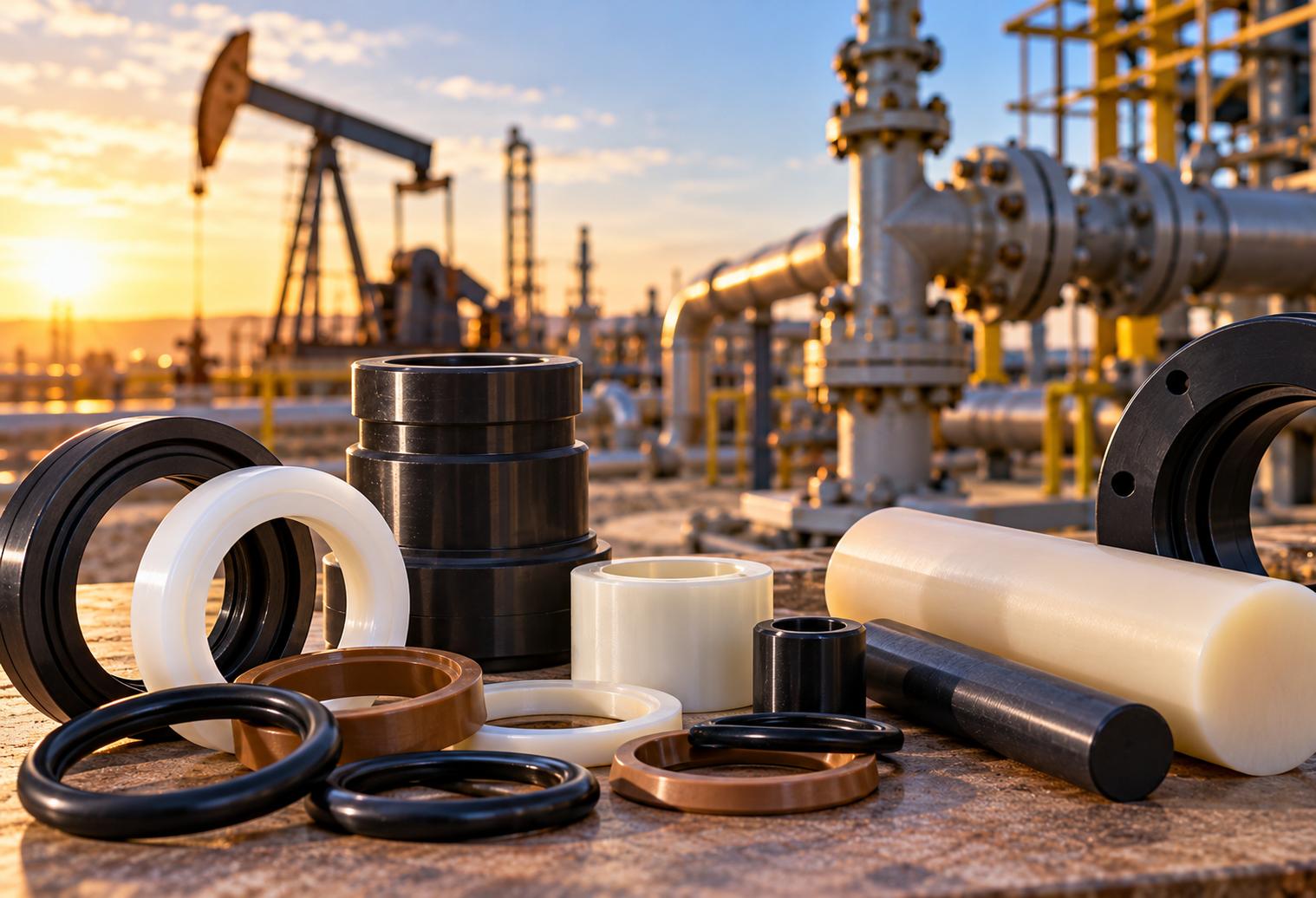
Oil and gas equipment operates under demanding conditions where extreme temperatures, high pressures, chemical exposure, and mechanical wear can shorten component lifespan. For industrial operations in Durant, Oklahoma, and throughout southeastern Oklahoma, choosing the wrong polymer material can lead to premature seal failure, equipment downtime, and costly maintenance.
Selecting high-performance polymers is one way to improve equipment reliability and reduce unnecessary component replacements.
Quick Answer: Extending component lifespan in oil and gas applications starts with selecting polymers that match the equipment’s operating temperature, pressure, chemical exposure, and mechanical requirements. Materials such as PTFE, PEEK, and specialized elastomers offer different levels of chemical resistance, dimensional stability, and wear performance. The right selection depends on the specific application, including whether the component functions as a seal, gasket, bearing, backup ring, or other critical part.
What Local Oil and Gas Operators Should Know
-
High-performance polymers can help extend the service life of seals, gaskets, and other components exposed to harsh operating conditions.
-
Durant’s hot summers and changing seasonal temperatures make proper storage and temperature compatibility important considerations for industrial sealing materials.
-
Oil and gas operations throughout Bryan County and southeastern Oklahoma may require materials capable of resisting hydrocarbons, pressure fluctuations, and chemical exposure.
-
Not every high-performance polymer works with every oilfield chemical or operating environment.
-
Proper component design, installation, and preventive maintenance are just as important as selecting a suitable polymer.
For businesses operating near Durant, Calera, Caddo, and surrounding communities, reliable sealing components help support consistent equipment performance.
At Tetrachem Seal Co Inc, we recognize the importance of selecting materials that match the demands of industrial applications. Understanding how different polymers perform helps equipment operators make informed decisions about component longevity.
Local Data or Field Observations: What Affects Polymer Performance in Southeastern Oklahoma?
Polymer performance in southeastern Oklahoma depends on operating conditions, environmental exposure, and the specific equipment involved. For oil and gas applications, temperature extremes, chemical compatibility, pressure cycling, and mechanical movement are among the most important considerations when evaluating component durability.
These are general engineering considerations rather than measurements from a specific local facility.
Durant and the surrounding Texoma region experience warm summers, seasonal temperature changes, and periods of significant humidity. Although process temperatures often exceed outdoor conditions, local weather can affect equipment storage, exposed components, and maintenance practices.
Industrial operations should evaluate several conditions before choosing a polymer:
-
Operating temperature: Materials must maintain their required properties across the equipment’s actual temperature range.
-
Chemical exposure: Hydrocarbons, treatment chemicals, lubricants, and cleaning agents can affect polymer compatibility.
-
Pressure fluctuations: Repeated pressure changes may contribute to seal deformation, extrusion, or fatigue.
-
Mechanical movement: Sliding and rotating applications introduce friction and wear.
-
Environmental exposure: Moisture, sunlight, and outdoor storage conditions can influence material performance.
Understanding these factors provides a stronger foundation for long-term component selection.
Local Impact: Why Polymer Selection Matters for Oil and Gas Equipment
Proper polymer selection helps Durant-area industrial operators reduce avoidable equipment interruptions, manage maintenance expenses, and protect critical components. A material that performs reliably under actual service conditions may last longer than one selected primarily for its initial purchase price.
For oil and gas operations throughout Bryan County, component failure can affect pumps, valves, compressors, and other essential equipment.
A damaged seal may cause fluid leakage, pressure loss, or reduced system efficiency. Depending on the application, these problems can require equipment shutdown and replacement parts.
Longer-lasting components can also support more predictable maintenance scheduling. Rather than repeatedly replacing unsuitable materials, operators can focus on selecting components designed for the application’s chemical, thermal, and mechanical demands.
Warning Signs: How to Recognize Polymer Component Failure
Polymer component failure often produces visible damage, leakage, or changes in equipment performance. Identifying these warning signs early helps maintenance teams determine whether a seal, gasket, or other polymer component requires inspection or replacement.
Watch for these seven indicators:
-
Visible leakage: Fluid or gas escaping around sealing surfaces may indicate deterioration or loss of sealing force.
-
Cracking or splitting: Physical damage can develop from chemical exposure, temperature stress, or repeated loading.
-
Excessive swelling: Some polymers absorb or react with fluids, causing dimensional changes.
-
Hardening or brittleness: Material aging or incompatible operating conditions can reduce flexibility.
-
Surface abrasion: Scoring, scratches, or uneven wear may indicate excessive friction or contamination.
-
Permanent deformation: A component that no longer returns to its intended shape may have experienced compression set or mechanical damage.
-
Repeated premature replacement: Frequent failures can indicate a mismatch between material properties and actual operating conditions.
For industrial facilities around Durant, recurring component problems deserve more than a routine replacement. Investigating the cause can help prevent the same failure from happening again.
When to Call a Professional for Polymer Material Selection
Professional polymer material selection becomes necessary when equipment operates under demanding temperatures, elevated pressures, aggressive chemical exposure, or critical sealing requirements. Specialized guidance is particularly valuable when repeated failures occur or when changing from an existing material to a higher-performance alternative.
Maintenance teams can safely document operating conditions, review manufacturer specifications, and inspect accessible components during approved maintenance procedures.
However, high-pressure oil and gas systems should only be opened, inspected, or serviced by appropriately trained personnel following established isolation and safety procedures.
For operations in Durant and nearby industrial communities, professional evaluation is especially useful when:
-
A component repeatedly fails before its expected maintenance interval.
-
Existing seals show chemical swelling or unusual wear.
-
Equipment operating temperatures or pressures have changed.
-
A replacement material is being considered for a critical application.
-
Material compatibility information is incomplete.
We encourage evaluating the complete application rather than relying on material names alone.
Common Local Causes of Premature Polymer Wear
Premature polymer wear in southeastern Oklahoma oil and gas equipment commonly relates to chemical incompatibility, temperature exposure, pressure-related deformation, mechanical abrasion, or installation problems. These are common engineering failure mechanisms, although their frequency at any individual facility depends on its equipment and operating conditions.
1. Chemical incompatibility
Exposure to incompatible hydrocarbons, additives, solvents, or treatment chemicals can cause swelling, softening, cracking, or loss of mechanical properties.
2. Temperature extremes
High operating temperatures may accelerate material degradation. Low temperatures can reduce flexibility in certain elastomers, increasing the possibility of leakage during startup.
3. Pressure-related extrusion
Under high differential pressure, a sealing material may deform into clearances between mating components. Proper seal design and backup rings can help manage this risk.
4. Friction and abrasion
Moving equipment can expose polymers to repeated contact, contamination, and surface wear. Material selection must account for movement, lubrication, and surface finish.
5. Improper installation or storage
Incorrect installation, incompatible lubricants, and poor storage practices can shorten component life before normal operation even begins.
For facilities in the Durant area, summer heat and outdoor storage conditions make proper handling and storage practices particularly relevant.
Prevention and Maintenance: How to Extend Polymer Component Lifespan
Extending polymer component lifespan requires matching materials to service conditions, following proper installation procedures, and inspecting equipment at appropriate intervals. Preventive maintenance is especially valuable for oil and gas operations where unexpected shutdowns can interrupt production or processing activities.
A practical maintenance approach includes:
-
Review material compatibility: Confirm suitability for every relevant process fluid and cleaning chemical.
-
Verify temperature limits: Consider continuous operating temperatures, startup conditions, and short-term excursions.
-
Evaluate pressure requirements: Check pressure ratings, extrusion gaps, and component geometry.
-
Inspect during planned shutdowns: Look for wear, deformation, cracking, and other deterioration.
-
Maintain installation standards: Use correct dimensions, approved lubricants, and manufacturer-recommended procedures.
-
Store components properly: Protect unused materials from excessive heat, sunlight, contamination, and unsuitable storage conditions.
Before the hottest months in Durant, maintenance teams can review outdoor component storage and the condition of exposed equipment.
Any inspection involving pressurized systems should follow approved safety procedures.
Expected Results: What High-Performance Polymers Can Improve
High-performance polymers can improve chemical resistance, wear behavior, thermal stability, or dimensional performance when properly matched to an oil and gas application. The achievable improvement depends on the material, component design, installation quality, and operating environment.
Potential benefits include longer replacement intervals, reduced leakage risk, more consistent sealing performance, and fewer material-related maintenance problems.
However, switching to a premium polymer does not automatically guarantee longer service life.
A component made from an unsuitable high-cost material may fail sooner than a conventional material correctly selected for the application.
The best results come from combining material compatibility, appropriate engineering design, and consistent maintenance.
Common Mistakes When Selecting Oil and Gas Polymers
Avoiding polymer selection mistakes helps southeastern Oklahoma industrial operators protect equipment and make better use of maintenance budgets. Three mistakes are particularly important.
Mistake 1: Choosing materials based only on price
Consequence: A lower initial cost may be offset by frequent replacements and equipment downtime.
Better approach: Compare expected service life, application suitability, and total maintenance costs.
Mistake 2: Assuming chemical resistance is universal
Consequence: A polymer that resists one hydrocarbon or chemical may perform poorly when exposed to another.
Better approach: Review chemical compatibility for the actual fluids, concentrations, and temperatures involved.
Mistake 3: Ignoring mechanical requirements
Consequence: A chemically resistant polymer may still experience excessive wear, creep, or extrusion.
Better approach: Evaluate pressure, movement, clearances, loading, and component geometry alongside chemical resistance.
Common Local Scenario: Repeated Seal Wear in Industrial Equipment
A common scenario for an oil and gas operation near Durant involves a pump that experiences repeated seal deterioration despite regular replacement. Maintenance personnel may notice leakage, uneven wear, or a shorter-than-expected replacement interval.
Replacing the same seal without investigating the cause may allow the problem to continue.
A more effective approach begins with reviewing the process fluid, operating temperature, pressure, shaft movement, and condition of the sealing surfaces.
If the existing material is incompatible with the operating environment, an alternative polymer or seal design may provide better performance.
This hypothetical scenario illustrates why material selection should be based on the complete operating system rather than replacement frequency alone.
Related Service Solutions: Choosing the Right High-Performance Polymer
Selecting the right high-performance polymer involves comparing the chemical, thermal, and mechanical properties of available materials against the equipment’s operating requirements. PTFE, PEEK, and engineered elastomers are common options for oil and gas components, but each serves different application needs.
PTFE: Chemical resistance and low friction
Polytetrafluoroethylene, commonly known as PTFE, offers broad chemical resistance and low friction characteristics.
It is used in various seals, gaskets, and other industrial components. Filled PTFE grades can provide improved wear or deformation resistance for certain applications.
PEEK: Mechanical strength and temperature performance
Polyether ether ketone, or PEEK, is an engineering thermoplastic known for its mechanical strength, chemical resistance, and performance at elevated temperatures.
It may be suitable for backup rings, bushings, and other components requiring dimensional stability.
Specialized elastomers: Flexible sealing performance
Materials such as FKM, HNBR, and certain FFKM grades can provide flexible sealing performance in demanding applications.
Their suitability depends on fluid chemistry, temperature, pressure, and other operating conditions. These materials are not interchangeable simply because they are all used in industrial sealing.
We recommend comparing actual service requirements before selecting a polymer family or specific compound.
Comparing Your Options: PTFE vs. PEEK vs. Specialized Elastomers
Comparing PTFE, PEEK, and specialized elastomers helps oil and gas operators identify materials that better match their sealing, wear, and structural requirements. The most appropriate choice depends on the component’s function and the conditions it must withstand.
| Material | Key strengths | Common applications |
|---|---|---|
| PTFE | Broad chemical resistance and low friction | Seals, gaskets, and wear components |
| PEEK | Mechanical strength and dimensional stability | Backup rings, bushings, and structural components |
| FKM | Elastic sealing and resistance to many oils and fuels | O-rings and static or dynamic seals |
| HNBR | Mechanical durability and resistance to many oilfield fluids | Seals and elastomeric components |
| FFKM | Broad chemical resistance and high-temperature capability in selected grades | Specialized critical sealing applications |
Specific compound grades and operating limits must be verified before use.
For Durant-area facilities, selecting a polymer based on documented operating conditions is more dependable than choosing a material solely because it is considered high performance.
Service Areas: Supporting Industrial Material Selection Around Durant
Durant, Oklahoma, is an important local reference point for industrial businesses throughout Bryan County and the Texoma region. Nearby communities include Calera, Caddo, Colbert, and Bokchito, with additional industrial activity across the broader southeastern Oklahoma and North Texas region.
Oil and gas equipment operators in these areas can benefit from evaluating polymer components for long-term durability and application compatibility.
Cost of Ignoring Premature Component Wear
Ignoring premature polymer wear can increase maintenance costs, contribute to equipment downtime, and create additional operational risks. For oil and gas facilities in southeastern Oklahoma, a recurring seal or gasket problem may indicate a material compatibility or equipment condition that requires attention.
Continued operation with a deteriorating component may allow leakage, contamination, or secondary equipment damage to develop.
The total cost of a component problem can include replacement materials, maintenance labor, lost operating time, and associated repairs.
Identifying the cause early helps operators make informed decisions about whether to maintain, redesign, or replace the affected component.
FAQ: High-Performance Polymers for Oil and Gas Applications
What is the best polymer for oil and gas sealing applications in Durant, OK?
The best polymer depends on the equipment’s operating temperature, pressure, fluid chemistry, and sealing requirements. PTFE, PEEK, FKM, HNBR, and FFKM may all be suitable for different applications. Durant-area operators should review the complete service environment before selecting a material or compound.
How do high-performance polymers extend equipment lifespan?
High-performance polymers can extend equipment lifespan by providing appropriate resistance to chemicals, heat, friction, and mechanical stress. When selected correctly, these materials may reduce premature deterioration and help maintain sealing performance. Proper component design, installation, and preventive maintenance remain essential to achieving reliable results.
Are PTFE seals suitable for oil and gas equipment in Bryan County?
PTFE seals can be suitable for oil and gas equipment in Bryan County when their material properties and design match the application. PTFE offers broad chemical resistance and low friction, but it also has limitations related to deformation and mechanical loading. Filled grades or additional design features may be necessary.
When should an oil and gas operator choose PEEK instead of PTFE?
PEEK may be preferable when an application requires greater mechanical strength, stiffness, or dimensional stability. PTFE may be advantageous where low friction and broad chemical resistance are priorities. The final decision should consider temperature, pressure, wear, chemical exposure, and the specific component design.
How does Oklahoma’s climate affect polymer components?
Oklahoma’s seasonal temperature changes, summer heat, sunlight, and humidity can affect the storage and environmental exposure of certain polymer components. Actual process conditions usually play a larger role in material selection for oil and gas equipment. Proper storage and verified temperature compatibility help reduce avoidable deterioration.
What causes oil and gas seals to fail prematurely?
Premature seal failure can result from chemical incompatibility, excessive temperature, pressure-related extrusion, abrasion, installation damage, or incorrect component dimensions. Maintenance teams should inspect failed components and review operating conditions to identify the likely cause. Replacing a seal without addressing the underlying issue may lead to repeated failures.
Can better polymer selection reduce downtime for Durant industrial facilities?
Better polymer selection can help reduce material-related downtime when premature wear or chemical incompatibility is contributing to equipment problems. Choosing components suited to actual operating conditions may support longer maintenance intervals and more reliable performance. Results depend on the equipment, operating practices, and other potential failure mechanisms.
How often should high-performance polymer seals be inspected?
Inspection frequency should follow equipment manufacturer recommendations, applicable maintenance procedures, operating conditions, and the consequences of failure. High-pressure or critical oil and gas systems may require more closely managed inspection programs. Operators should also investigate unusual leakage, temperature changes, or repeated component failures rather than waiting for scheduled maintenance.
Are high-performance polymers worth the additional cost for southeastern Oklahoma operators?
High-performance polymers may justify a higher purchase price when they improve component longevity, reduce replacement frequency, or help prevent expensive equipment interruptions. The decision should consider total operating cost rather than material price alone. A more expensive polymer is only worthwhile when its properties provide a meaningful advantage for the application.
Protect Oil and Gas Equipment With Smarter Polymer Selection
Selecting high-performance polymers is an important part of extending component lifespan and maintaining dependable oil and gas equipment. For businesses throughout Durant and southeastern Oklahoma, understanding chemical compatibility, mechanical requirements, and environmental exposure can help prevent avoidable material failures.
At Tetrachem Seal Co Inc, we believe informed material selection starts with understanding the application and the conditions each component must withstand.
Improve Component Reliability for Your Durant Oil and Gas Operation
Make informed polymer material decisions that support equipment durability, maintenance planning, and long-term performance.