

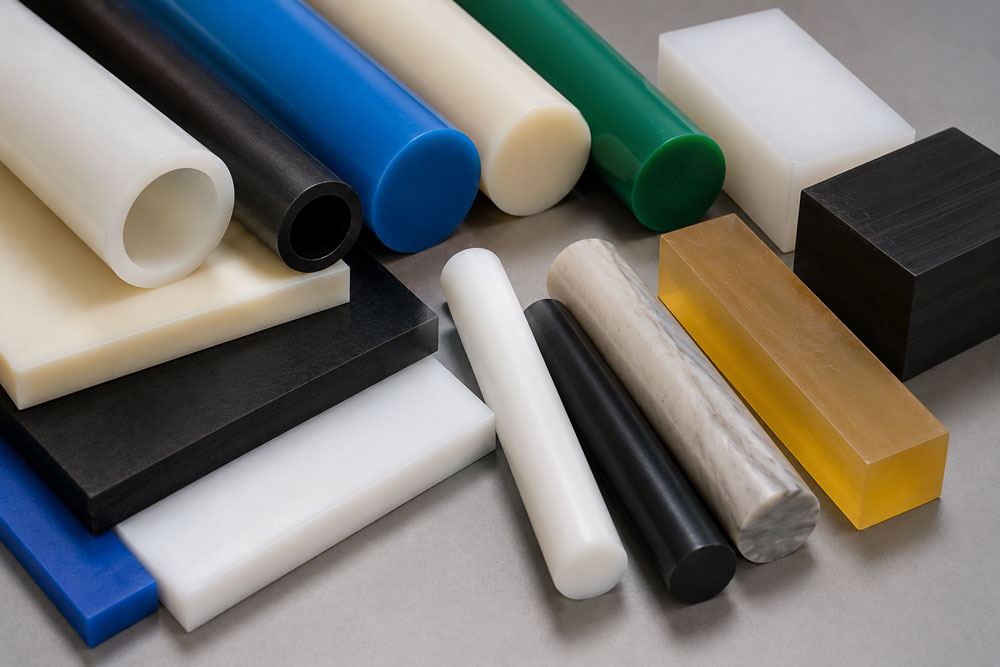
Choosing a polymer for chemical processing equipment is rarely as simple as finding a plastic labeled “chemical resistant.” For facilities in Durant and across southern Oklahoma, the right material must handle the actual chemical, concentration, temperature, pressure, mechanical load, and exposure cycle involved in the process.
A material that performs well in a room-temperature compatibility chart may behave very differently in a heated process line, pump, valve, seal assembly, or component exposed to repeated pressure and temperature changes.
Quick answer: Polymer selection for chemical processing should be based on the complete operating environment, not chemical resistance alone. PTFE, PEEK, PVDF, polypropylene, polyethylene, and other engineering plastics each offer different combinations of chemical resistance, temperature capability, strength, wear performance, dimensional stability, and cost. Final selection should be verified against the specific chemical concentration, operating temperature, pressure, mechanical stress, and expected service conditions.
What local processors should know
-
Chemical compatibility can change significantly as temperature, concentration, pressure, or exposure time increases.
-
Durant-area industrial facilities may also need to account for high ambient summer temperatures when evaluating equipment and materials in outdoor or non-climate-controlled areas.
-
A polymer with excellent chemical resistance may still be unsuitable when a component requires substantial mechanical strength, dimensional stability, or wear resistance.
-
Mixed chemicals and changing process conditions require more scrutiny than a compatibility chart for one chemical under laboratory conditions.
-
Bryan County businesses should evaluate the full component and system, including seals, mating surfaces, hardware, pressure, movement, and cleaning procedures.
Why Does Polymer Selection Matter in Chemical Processing?
Polymer selection matters because chemical exposure can change a plastic’s strength, dimensions, surface condition, and useful service life even when failure is not immediately visible. Selecting a material for its actual operating conditions helps reduce the risk of swelling, softening, cracking, excessive wear, leakage, or premature component replacement.
This is particularly relevant for industrial operations around Durant, Bryan County, Calera, and the U.S. 69/75 corridor, where manufacturing and other industrial activity form an important part of the regional economy. The Durant Industrial Authority identifies manufacturing as part of the area’s diverse economy and highlights the community’s highway and rail access.
Tetrachem Seal Co Inc is located in Durant, Oklahoma. When we evaluate polymer choices, the useful question is not simply, “Is this material resistant to this chemical?” The better question is, “Will this material remain suitable under the complete set of conditions in this application?”
What Factors Determine Chemical Compatibility?
Chemical compatibility is determined primarily by the chemical involved, its concentration, operating temperature, exposure duration, pressure, and mechanical stress on the component. These variables should be evaluated together because changing one condition can alter how a polymer behaves.
Material compatibility data commonly assumes specific laboratory conditions. Real chemical processing systems may involve hotter fluids, concentrated solutions, startup and shutdown cycles, vibration, compression, abrasion, or chemical mixtures.
Important selection factors include:
-
Chemical type and formulation
-
Chemical concentration
-
Continuous and peak temperatures
-
Operating and surge pressure
-
Duration and frequency of exposure
-
Mechanical loading
-
Abrasion or suspended solids
-
Required dimensional stability
-
Movement or sliding contact
-
Cleaning and sanitation chemicals
-
Outdoor or ambient environmental exposure
Published chemical-resistance guidance also warns that temperature, concentration, exposure time, and mechanical loading can materially affect performance. Testing under representative service conditions may be appropriate when the application falls outside established compatibility information.
How Do Common Chemical-Processing Polymers Compare?
Common chemical-processing polymers differ most in chemical resistance, heat capability, strength, stiffness, wear behavior, and cost, so there is no single best plastic for every application. A useful shortlist may include PTFE, PVDF, PEEK, polypropylene, and polyethylene, depending on the job.
PTFE
PTFE is widely considered where broad chemical resistance and low friction are priorities. It can be useful in applications involving aggressive media, but designers must also consider its mechanical properties, deformation under sustained load, and dimensional requirements.
PTFE may be evaluated for components such as seals, gaskets, seats, liners, and other chemically exposed parts when its complete property profile fits the application.
PVDF
PVDF combines chemical resistance with greater rigidity than some fluoropolymers and is used in chemical-fluid handling applications. Depending on the grade and conditions, it can be considered for piping components, pumps, tubing, tanks, filtration equipment, and related fluid-handling systems.
PVDF should still be checked carefully against temperature, chemical concentration, stress, and the exact medium involved.
PEEK
PEEK is a high-performance engineering thermoplastic often considered when an application requires chemical resistance combined with elevated-temperature performance and mechanical strength.
Its performance characteristics can make it relevant where lower-temperature commodity plastics do not provide the required combination of stability and strength. The higher material cost, however, means it should be chosen because the operating requirements justify it rather than simply because it is a high-performance polymer.
Polypropylene
Polypropylene can be an economical option for many chemical environments and may be considered for tanks, piping-related components, and other equipment where its temperature and mechanical capabilities are sufficient.
It should not automatically be substituted for a higher-performance polymer simply because both materials show resistance to a particular chemical at room temperature.
Polyethylene and UHMW-PE
Polyethylene materials can offer useful chemical resistance, while UHMW-PE is also valued in applications where abrasion and wear behavior matter.
Temperature limits, dimensional requirements, mechanical loading, and the exact chemical environment must still be considered before specifying these materials for processing equipment.
What Are the Warning Signs of the Wrong Polymer?
Warning signs of an unsuitable polymer include swelling, softening, cracking, distortion, unusual wear, leakage, discoloration, and changes in component dimensions. Any unexplained physical change in a chemically exposed plastic component deserves attention before the condition progresses.
Watch for:
-
A seal or component that has visibly swollen
-
Cracking or crazing near stressed areas
-
Softened or tacky surfaces
-
Unexpected brittleness
-
Repeated leaks after otherwise normal installation
-
Excessive wear on moving components
-
Distortion or loss of dimensional fit
-
Shorter replacement intervals than previously expected
For Durant processing facilities, repeated failures should not automatically be treated as maintenance problems. The material itself, process temperature, chemical concentration, pressure, or equipment conditions may have changed.
When Should You Request Professional Material Selection Help?
Professional material-selection help is appropriate when chemicals are aggressive, operating temperatures are elevated, the process involves pressure, failure could interrupt production, or compatibility data does not closely match actual conditions. It is also appropriate when several polymers appear acceptable on paper but have very different mechanical properties.
A basic compatibility chart can help create a shortlist. It should not substitute for application-specific review when a component operates under demanding conditions.
DIY review can reasonably include identifying the exact chemical, concentration, temperatures, pressure, existing component material, and observed failure mode. Selecting a replacement solely from a generic online chart is where the risk increases.
What Common Conditions Cause Polymer Components to Fail?
Polymer components commonly fail because the application exceeds the material’s chemical, thermal, mechanical, or dimensional capabilities rather than because the plastic is inherently defective. Understanding the failure mechanism is essential before replacing a component with the same material.
1. Higher-than-expected temperature
Chemical resistance may decrease as temperature rises. Southern Oklahoma heat can also add to equipment temperatures in outdoor installations or buildings without controlled environments. National Weather Service reports in 2026 included periods of extreme summer heat affecting Bryan County.
2. Chemical concentration changes
A material suitable for a diluted chemical may respond differently when concentration increases.
3. Mechanical stress
Compression, tension, vibration, bending, and assembly stress can contribute to cracking or deformation.
4. Chemical mixtures
Compatibility with individual chemicals does not necessarily predict performance when those chemicals are mixed or react with one another.
5. Abrasion
Suspended solids or continuous sliding contact can wear a chemically compatible polymer faster than expected.
6. Process cycling
Repeated heating, cooling, pressurization, and depressurization can create stresses that are absent during steady-state laboratory testing.
How Can Durant Facilities Reduce Premature Polymer Failure?
Durant facilities can reduce premature polymer failure by documenting operating conditions, inspecting components routinely, tracking changes in the process, and verifying materials before substitutions are made. Preventive material management is particularly valuable when a small component can cause significant process downtime.
Useful practices include recording the chemical name and concentration, normal and maximum temperatures, operating pressure, equipment cleaning procedures, component dimensions, and known material grade.
Seasonal inspections may also make sense for equipment exposed to southern Oklahoma outdoor temperatures. Look for deformation, leaks, brittle areas, surface changes, and evidence that mounting or piping stresses have changed.
DIY inspection should remain visual unless personnel are trained and authorized to work on the equipment. Pressurized, hot, corrosive, or otherwise hazardous systems require appropriate industrial safety procedures.
What Results Should You Expect From Better Material Selection?
Better material selection should produce a component that more appropriately matches the chemical, temperature, pressure, mechanical, and wear requirements of the application. The practical goal is predictable performance rather than choosing the most expensive or technically advanced plastic available.
A successful change may improve component stability, reduce abnormal wear, or eliminate a specific incompatibility that contributed to previous failures. Actual service life will still depend on the operating environment, installation, component design, maintenance, and process consistency.
No polymer should be assumed to provide unlimited service life.
What Mistakes Should Chemical Processors Avoid?
Chemical processors should avoid selecting plastics from chemical-resistance ratings alone because those ratings may not represent the conditions inside an operating system.
Mistake: Choosing solely by chemical name.
Consequence: Temperature, concentration, or pressure may make the material unsuitable.
Better approach: Document the full operating envelope.
Mistake: Assuming all grades of a polymer perform identically.
Consequence: Fillers, reinforcement, processing, or formulation differences can affect properties.
Better approach: Evaluate the actual grade being considered.
Mistake: Replacing a failed component without investigating why it failed.
Consequence: The same failure can repeat.
Better approach: Review chemical exposure, temperature, pressure, movement, wear, and installation conditions.
Mistake: Automatically upgrading to the highest-performance material.
Consequence: Cost may increase without solving the actual problem.
Better approach: Select the material that satisfies the application’s documented requirements.
What Is a Common Local Material-Selection Scenario?
A common Durant-area scenario is a processor experiencing repeated deterioration of a plastic or sealing component and assuming that another material with a higher chemical-resistance rating will solve the problem. In practice, the investigation needs to go further.
Suppose the process chemical has remained unchanged, but the operating temperature recently increased. The replacement decision should consider whether heat is changing chemical resistance, dimensional stability, compression behavior, or mechanical strength.
This is a representative scenario, not a Tetrachem Seal Co Inc customer case study.
What Polymer Selection Solutions Are Available?
Polymer selection solutions begin with matching the component material to the exact application rather than relying on a one-size-fits-all recommendation. That means reviewing chemical exposure alongside temperature, pressure, movement, wear, dimensions, and the function the component must perform.
For applications involving seals or other polymer components, we recommend gathering as much operating information as possible before evaluating alternatives.
How Should You Compare Your Polymer Options?
Polymer options should be compared according to the properties that actually control performance in your process, with chemical resistance serving as one criterion rather than the only criterion.
| Selection Factor | What to Evaluate |
|---|---|
| Chemical resistance | Exact chemical, mixture, and concentration |
| Temperature | Normal, startup, cleaning, and maximum conditions |
| Mechanical strength | Loads, pressure, compression, and equipment stresses |
| Wear | Sliding, abrasion, and particulate exposure |
| Dimensional stability | Tolerances and acceptable deformation |
| Processing environment | Cleaning agents, cycles, outdoor exposure, and contamination requirements |
| Cost | Total application requirements rather than raw material price alone |
A less expensive polymer may be completely appropriate in one application. A higher-performance material such as PEEK may be justified in another. PTFE or PVDF may be more suitable where the chemical environment drives the decision.
What Areas Can Benefit From Application-Specific Polymer Selection?
Application-specific polymer selection can benefit chemical-processing and industrial operations throughout Durant and the surrounding Bryan County area. Nearby communities include Calera, Colbert, Caddo, and Bokchito, while Lake Texoma and the North Texas border help define the broader southern Oklahoma region.
The U.S. 69/75 corridor also connects Durant with North Texas and the Dallas-Fort Worth market, making material reliability relevant to industrial operations serving customers throughout the region.
What Can Happen If an Incorrect Polymer Stays in Service?
Leaving an incompatible polymer in service can lead to continued swelling, cracking, deformation, wear, leakage, repeated replacement, or unplanned equipment downtime. The appropriate response depends on the severity of the deterioration and the consequences of component failure.
Waiting is especially risky when the component contains process chemicals, operates under pressure, or performs a sealing or safety-related function.
The objective is not to replace every aging plastic component immediately. It is to identify abnormal deterioration early enough to investigate the material and operating conditions before a larger process problem develops.
FAQ
What is the best plastic for chemical processing in Durant, OK?
There is no single best plastic for chemical processing in Durant because the correct material depends on the chemical, concentration, temperature, pressure, mechanical load, and component function. PTFE, PVDF, PEEK, polypropylene, and polyethylene can each be appropriate under different conditions.
Is PTFE always the best choice for aggressive chemicals?
No. PTFE offers broad chemical resistance, but chemical resistance is only part of material selection. Mechanical load, deformation, temperature, dimensional tolerances, wear, pressure, component design, and cost may make another polymer or material system more appropriate for a particular application.
Can Oklahoma summer heat affect polymer components?
Yes, ambient heat can contribute to the thermal conditions experienced by outdoor or non-climate-controlled equipment. Bryan County experiences periods of significant summer heat, so processors should evaluate actual component temperature rather than assuming the surrounding air or process always stays near room-temperature compatibility-chart conditions.
What information should a Durant facility provide when selecting a polymer?
A Durant facility should provide the exact chemical or mixture, concentration, operating and maximum temperatures, pressure, component function, dimensions, movement, mechanical loading, cleaning chemicals, and previous material if known. Information about the existing failure pattern can also help narrow the material-selection question.
Can a chemical-resistance chart guarantee polymer performance?
No. A chemical-resistance chart is a screening tool rather than a guarantee of performance in every application. Laboratory ratings may use different temperatures, concentrations, exposure periods, and mechanical conditions than the actual system. Unusual mixtures or demanding applications may require additional evaluation or representative testing.
Why would PEEK be considered instead of a lower-cost plastic?
PEEK may be considered when an application requires a demanding combination of elevated-temperature capability, mechanical strength, dimensional performance, and chemical resistance. It should not automatically replace lower-cost plastics, however. The application requirements should justify the additional performance and material cost.
How does PVDF differ from PTFE in chemical-processing equipment?
PVDF and PTFE are both fluoropolymers, but they have different mechanical, thermal, processing, and chemical-resistance characteristics. PVDF offers useful rigidity and is widely used in fluid-handling applications, while PTFE is known for very broad chemical resistance and low friction. Selection should be application-specific.
Should Bryan County processors replace a polymer after the first sign of swelling?
Visible swelling should prompt an evaluation because it may indicate that the chemical is affecting the material. Whether immediate replacement is required depends on the component, severity, process hazards, and equipment conditions. Components containing hazardous chemicals or operating under pressure should be addressed using appropriate professional and facility safety procedures.
Choose Materials Around the Process, Not Just the Compatibility Chart
Polymer selection for chemical-processing equipment requires a complete picture of the application. For Durant and southern Oklahoma facilities, that means considering chemical exposure together with temperature, pressure, mechanical stress, wear, component design, and local operating conditions.
A carefully selected material is one that fits the real process rather than simply looking good on a chart.
Build a More Reliable Material Solution for Your Durant Operation
Start with the actual process conditions, and we can help you evaluate the requirements that matter most to the application.