

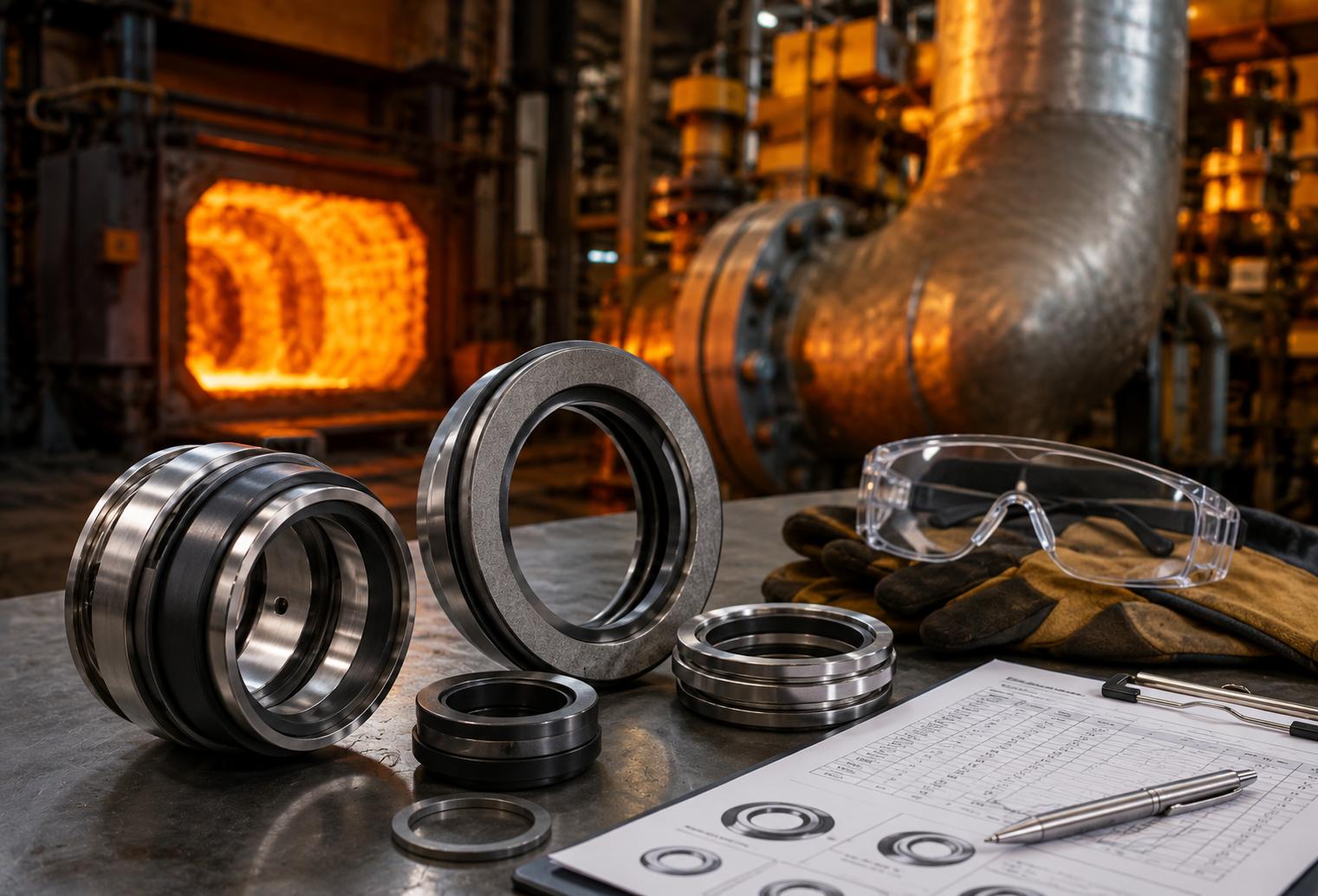
Extreme process temperatures can turn a small sealing problem into lost production, damaged equipment, or an unexpected maintenance shutdown. For industrial operations in Durant and across southern Oklahoma, choosing a seal based on temperature alone is not enough. Chemical exposure, pressure, motion, equipment design, and operating cycles all affect how long a seal can perform.
The right industrial chemical seal must tolerate the actual combination of heat, process media, pressure, movement, and exposure time in the application. Materials such as FKM, FFKM, and PTFE may all be considered for elevated-temperature service, but their suitability varies considerably by chemical and operating condition. A seal should be selected from verified compatibility data for the specific application rather than from a general temperature rating.
What local operations should know
-
A material rated for high temperatures may still fail if the process chemical attacks it at the actual operating temperature.
-
Durant’s location along the U.S. Highway 69/75 corridor connects local operations with a broader manufacturing and industrial market across southern Oklahoma and North Texas.
-
Ambient summer heat around Bryan County can add to the thermal load already created by hot process equipment.
-
Dynamic seals can experience additional heat at the sealing surface because of friction.
-
Chemical concentration, pressure spikes, startup cycles, and shutdown conditions should be considered before specifying a seal.
Why High-Temperature Seal Selection Matters in Durant
High-temperature seal selection matters in Durant because industrial equipment must manage process heat while operating in a southern Oklahoma environment where hot summer conditions can increase the surrounding thermal load. The seal still has to maintain chemical compatibility, dimensional stability, and adequate sealing force while equipment moves through normal production, startup, and shutdown cycles.
The City of Durant identifies manufacturing as one component of the area’s diverse economy and describes the community as a southern Oklahoma hub positioned along U.S. Highway 69/75. That location also places Durant roughly between operations throughout Bryan County and the North Texas industrial market.
For facilities near Durant, Calera, Caddo, Colbert, and other Texoma communities, seal reliability can affect pumps, valves, processing equipment, fluid-transfer systems, and other equipment where leakage or downtime matters.
Tetrachem Seal Co Inc is located in Durant, Oklahoma. When evaluating a high-temperature chemical sealing application, we recommend looking at the complete operating environment rather than choosing a material from temperature rating alone.
Local Data and Industrial Field Considerations
The most useful local consideration is that outdoor heat can compound an already demanding process environment, while the seal’s true limits are still determined primarily by the equipment’s internal temperature and chemical exposure. Southern Oklahoma summer conditions therefore belong in the operating review, especially for equipment installed outdoors or in poorly cooled industrial areas.
The City of Durant describes the community as the Bryan County seat and notes its connection to the Dallas-Fort Worth region through U.S. Highway 69/75. Local facilities may therefore support operations, suppliers, and customers throughout the Texoma region.
For actual seal selection, equipment data is more important than outdoor temperature alone. Record the normal process temperature, maximum upset temperature, chemical concentration, operating pressure, cycle duration, and whether the seal is static, reciprocating, or rotary.
How Extreme Heat Affects Industrial Chemical Seals
Extreme heat can accelerate chemical attack, increase permanent deformation, reduce sealing force, and expose weaknesses that may not appear under room-temperature compatibility testing. A material that performs acceptably during a short, cool laboratory exposure can behave differently after prolonged contact with the same chemical at elevated process temperatures.
High temperatures may contribute to:
-
Compression set and reduced elastic recovery
-
Hardening, softening, swelling, or cracking
-
Loss of sealing force
-
Faster chemical degradation
-
Increased extrusion risk under pressure
-
Friction-related heat in dynamic applications
-
Shorter maintenance intervals
This is particularly important around Durant facilities where outdoor equipment may already be absorbing significant environmental heat before internal process temperatures are considered.
Warning Signs That a High-Temperature Seal May Be Wrong for the Application
A high-temperature seal may be unsuitable when repeated leakage, visible material changes, shortened replacement intervals, or failures following temperature excursions become part of normal operation. These symptoms should prompt a review of both the seal material and the application rather than automatic installation of the same replacement.
Watch for:
-
Seals that become unusually hard or brittle
-
Swelling or noticeable dimensional changes
-
Cracking, blistering, or surface deterioration
-
Flattened seals that do not recover after removal
-
Leakage that appears only after equipment reaches operating temperature
-
Increasingly frequent replacement intervals
-
Seal damage concentrated on moving surfaces
-
Failures following process upsets or cleaning cycles
Which Seal Materials Work in High-Temperature Chemical Environments?
FKM, FFKM, and PTFE are common materials considered for high-temperature chemical applications, but none should be selected solely because it belongs to a particular material family. Individual compounds differ, and the correct choice depends on the process fluid, temperature, pressure, motion, seal geometry, and required service life.
FKM can provide useful elevated-temperature performance and resistance to many oils and chemicals. However, chemical compatibility varies, and some fluids can make particular FKM compounds inappropriate.
FFKM is designed for demanding combinations of chemical exposure and heat. Published technical literature from major sealing-material manufacturers lists certain FFKM compounds for temperatures above 600°F, but temperature capability is compound-specific rather than universal.
PTFE provides very broad chemical resistance and performs across a wide temperature range. Because PTFE behaves differently from elastomeric seals, equipment design, energization, movement, pressure, and sealing geometry must also be considered.
For Durant-area equipment, the better question is not simply, “Which material handles the most heat?” It is, “Which specific compound and seal design handles this chemical, at this temperature, in this equipment?”
Common Causes of Premature Seal Failure
Premature high-temperature seal failures most often result from a mismatch between the selected material and the complete operating conditions rather than temperature by itself. Heat frequently magnifies another issue, such as chemical incompatibility, incorrect installation, excessive pressure, poor surface conditions, or unexpected equipment movement.
Common contributors include:
-
Chemical incompatibility: Elevated temperatures can make chemical attack occur faster.
-
Temperature excursions: Startup problems or process upsets may exceed the normal operating range.
-
Incorrect seal geometry: A suitable material can still perform poorly in an unsuitable gland or sealing configuration.
-
Pressure and extrusion: High pressure can force softened material into equipment clearances.
-
Dynamic friction: Rotary or reciprocating movement can create additional heat at the seal interface.
-
Installation damage: Twisting, cutting, contamination, or incorrect lubrication can shorten seal life before production begins.
How to Prevent High-Temperature Seal Problems
The best way to prevent high-temperature seal problems is to document the complete application, verify chemical compatibility at the actual operating temperature, and inspect sealing systems before failures become repetitive. Maintenance teams around Durant should also distinguish normal process conditions from maximum upset conditions when creating seal specifications.
Record the chemical name and concentration, minimum and maximum temperatures, pressure range, equipment motion, speed when applicable, seal dimensions, and expected exposure time.
During planned maintenance, inspect removed seals rather than immediately discarding them. Changes in hardness, swelling, flattening, cracking, or wear patterns can provide useful clues about what is happening inside the equipment.
DIY observation can help identify symptoms. Material selection, dimensional changes, equipment modifications, and critical chemical-service applications should be reviewed by qualified sealing or equipment professionals.
What Results Should You Expect From Better Seal Selection?
A properly matched seal should provide more predictable performance under the application’s actual temperature, chemical, pressure, and movement conditions, although no material selection can guarantee a specific service life without application-specific evaluation. Better specifications can also make recurring failures easier to diagnose and maintenance intervals easier to plan.
For local manufacturers and processors, that can mean fewer emergency replacements, better maintenance scheduling, and less uncertainty about why a seal repeatedly fails.
The goal is not necessarily to specify the most expensive or highest-temperature material. The goal is to use the appropriate material and design for the real operating envelope.
Common Seal-Selection Mistakes
The most common seal-selection mistake is treating a published maximum temperature as proof that a material is suitable for the entire application. Temperature ratings provide useful screening information, but chemical compatibility, pressure, movement, duration, and compound formulation still have to be evaluated.
Mistake: Choosing only by maximum temperature.
Consequence: The seal may tolerate the heat but react poorly with the chemical.
Better approach: Evaluate temperature and chemical compatibility together.
Mistake: Using room-temperature chemical data for a hot process.
Consequence: Actual degradation can be more severe than expected.
Better approach: Verify compatibility at conditions representative of service.
Mistake: Replacing repeated failures with the identical seal.
Consequence: The underlying mismatch continues.
Better approach: Examine failed components and review the application specification.
A Common Durant-Area Industrial Scenario
A common local scenario involves process equipment that operates reliably at moderate temperature but begins leaking more frequently during hotter operating periods or after production conditions change. This is not a specific customer case study, but it illustrates why troubleshooting should include the process and surrounding operating conditions.
Imagine a facility in the Durant or Bryan County area operating a chemical-transfer pump. The original seal was selected using chemical compatibility information and normal process temperature. Later, process temperatures increase, equipment cycles become longer, or the chemical concentration changes.
Simply replacing the old seal may temporarily stop the leak. Reviewing the material, maximum temperature, chemical concentration, pressure, movement, and seal condition provides a better basis for choosing the next solution.
Related Industrial Seal Solutions
The appropriate sealing solution may involve changing the material, compound, seal profile, or overall sealing arrangement rather than merely replacing an existing part with an identical component. O-rings, gaskets, PTFE-based seals, elastomeric seals, and application-specific sealing components can each serve different purposes under demanding chemical and thermal conditions.
Comparing FKM, FFKM, and PTFE
FKM, FFKM, and PTFE each offer different balances of heat resistance, chemical compatibility, elasticity, and application requirements, so the best material depends on the complete operating environment. For Durant-area industrial teams, a side-by-side material review is more useful than selecting whatever material carries the highest advertised temperature rating.
| Material | Useful Strength | Key Selection Concern |
|---|---|---|
| FKM | Elevated-temperature performance with resistance to many oils and chemicals | Compatibility varies considerably by fluid and formulation |
| FFKM | Very broad chemical resistance and availability in compounds for extreme temperatures | Compound selection and application requirements remain important |
| PTFE | Extremely broad chemical resistance and wide temperature capability | Different mechanical and sealing behavior from elastomers |
Always evaluate the specific grade or compound rather than assuming all materials in one family perform identically.
Service Areas
Durant is the primary local focus, with industrial needs extending into surrounding Bryan County and the broader Texoma region. Businesses in communities such as Calera, Caddo, Colbert, and nearby southern Oklahoma areas may face many of the same chemical-processing, equipment-reliability, and high-temperature sealing questions.
What Does Ignoring a Seal Problem Cost?
Ignoring a recurring seal problem can increase the risk of leakage, unplanned downtime, secondary equipment damage, product loss, and repeated maintenance labor. For industrial facilities in Durant, waiting can be particularly disruptive when a critical pump, valve, or processing component becomes the reason an entire production step must stop.
A seal that repeatedly fails should be treated as information about the application, not simply as a disposable maintenance item.
FAQ
What is the best seal material for high temperatures in Durant industrial equipment?
There is no single best material for every high-temperature application in Durant. FKM, FFKM, PTFE, and other materials may be appropriate depending on the chemical, maximum operating temperature, pressure, motion, and equipment design. Selection should be based on a specific compound’s verified compatibility with the actual service conditions.
Is FFKM always better than FKM for extreme heat?
No, FFKM is not automatically the better choice for every application. Certain FFKM compounds offer exceptionally broad chemical resistance and very high temperature capabilities, but application requirements and cost also matter. A correctly selected FKM may be suitable where its temperature and chemical limits comfortably cover the actual process.
Can summer heat in Durant affect industrial seal performance?
Yes, Durant’s summer heat can add to the surrounding thermal load on outdoor or poorly cooled equipment, but internal process conditions generally remain the primary concern. Maintenance teams should evaluate ambient temperature alongside process temperature, frictional heat, equipment ventilation, operating duration, and any unusual temperature excursions.
Why does chemical compatibility change at high temperatures?
Chemical reactions and material degradation can accelerate as temperature rises, making some room-temperature compatibility information inadequate for hot service. A seal that appears resistant during a short exposure may swell, harden, soften, or lose useful properties after longer exposure at the actual process temperature.
What information should a Bryan County facility gather before selecting a seal?
A Bryan County facility should document the chemical and concentration, normal and maximum temperature, minimum and maximum pressure, equipment motion, speed when relevant, dimensions, exposure duration, and history of previous failures. Accurate application information makes it easier to eliminate materials that are unsuitable before they reach the equipment.
Should a Durant plant replace a repeatedly failing seal with the same material?
Not automatically. A repeatedly failing seal in a Durant facility should trigger an application review before another identical replacement is installed. Examining the failed seal and checking temperature, chemical exposure, pressure, equipment clearances, installation practices, and recent process changes can help identify why service life has become unacceptable.
Can PTFE handle aggressive industrial chemicals?
PTFE has extremely broad chemical resistance and is widely considered for aggressive chemical environments, but chemical resistance alone does not determine whether it is the correct seal. Pressure, temperature, movement, equipment geometry, creep behavior, and the particular seal design must also suit the application.
When should a Texoma-area operation consult a seal professional?
Professional input is appropriate when chemical service is hazardous or critical, temperatures approach material limits, failures repeat, operating conditions have changed, or a wrong selection could cause significant downtime or equipment damage. A detailed application review is especially valuable before changing materials solely on the basis of a published temperature rating.
Choose a Seal for the Whole Application, Not Just the Temperature
For industrial operations in Durant and across the Texoma region, high-temperature seal selection is a combination of material science and application details. Chemical compatibility, heat, pressure, motion, exposure duration, and equipment geometry should work together in the specification.
Reduce the Risk of Repeat High-Temperature Seal Failures
Get the application conditions right before choosing the next sealing material.