

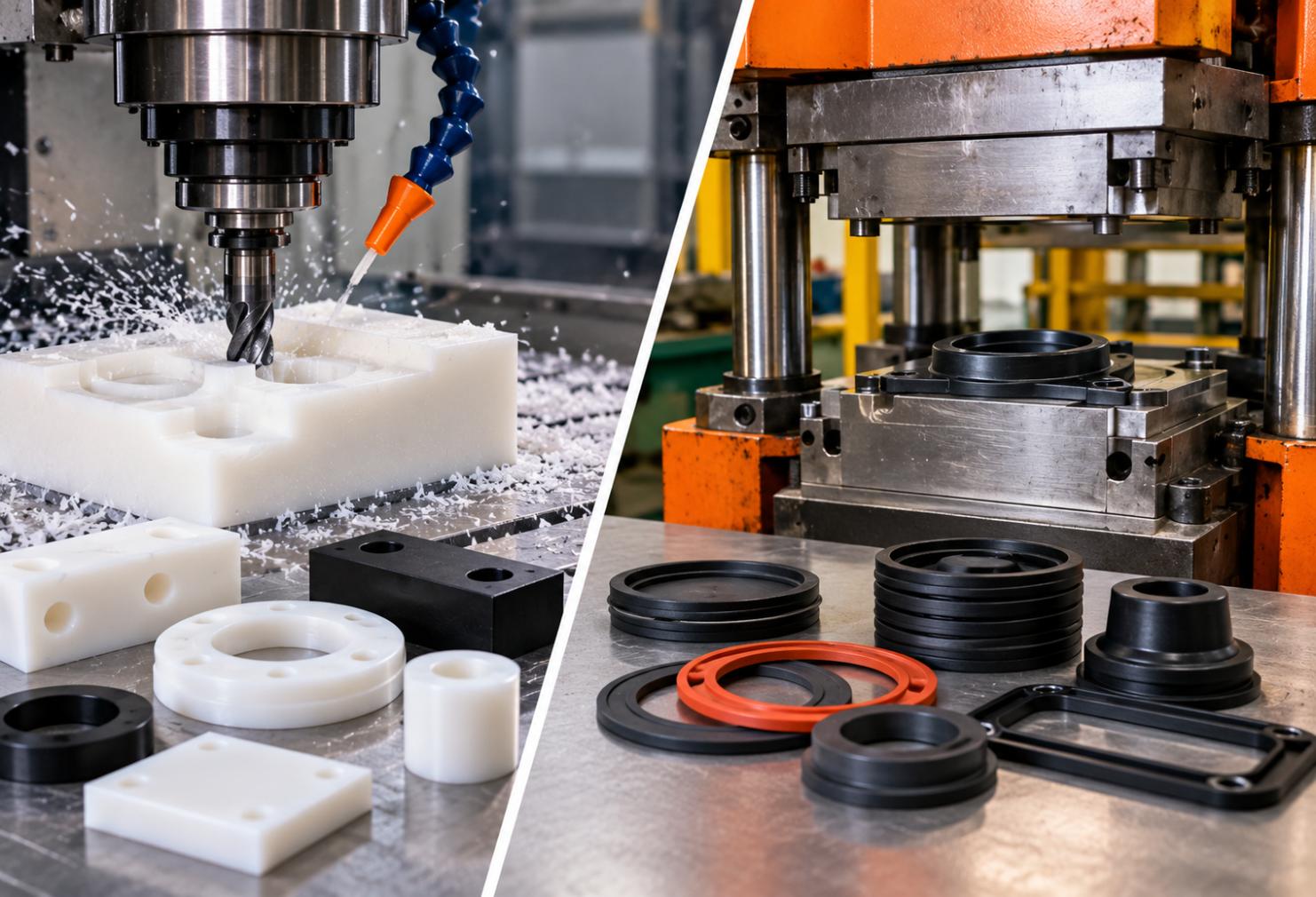
Choosing the right manufacturing process for custom plastic parts can affect everything from production costs to dimensional accuracy and long-term performance. For manufacturers, equipment operators, and industrial businesses in Durant, OK, selecting between CNC plastic machining and compression molding is an important decision. The wrong process can lead to unnecessary tooling expenses, production delays, or components that do not meet application requirements.
Understanding how these two methods compare can help businesses throughout Bryan County make informed decisions about custom plastic components.
Quick Answer: CNC plastic machining is generally best for custom plastic parts requiring tight tolerances, complex features, prototypes, or low-volume production. Compression molding is often better suited for repeat production of parts made from compatible thermosetting materials, particularly when tooling costs can be distributed across larger quantities. The best choice depends on material requirements, part geometry, production volume, dimensional tolerances, and total manufacturing costs.
What Durant Businesses Should Know
-
CNC machining offers flexibility. It produces precise plastic components from solid stock without requiring dedicated molding tools.
-
Compression molding supports repeat production. Once suitable tooling is developed, the process can manufacture consistent parts in larger quantities.
-
Material selection matters. Industrial operations in Bryan County may require plastics that withstand chemicals, friction, elevated temperatures, or mechanical stress.
-
Production volume influences cost. Small production runs often favor machining, while recurring orders may justify compression molding tooling.
-
Part design affects the decision. Businesses around Durant and southern Oklahoma should consider tolerances, component complexity, and expected operating conditions before selecting a manufacturing method.
For local industrial buyers, the goal is not simply finding the fastest manufacturing process. It is choosing a method that delivers the necessary performance without unnecessary production expense.
At Tetrachem Seal Co Inc, we understand the importance of evaluating custom plastic components based on their intended applications, material properties, and manufacturing requirements. Making the right process selection starts with understanding what each method can realistically deliver.
CNC Plastic Machining vs. Compression Molding: Local Manufacturing Considerations
CNC plastic machining and compression molding serve different manufacturing needs for Durant-area businesses. Machining is particularly useful for precision components and changing designs, while compression molding can offer advantages for repeatable production using compatible materials. Evaluating both methods early helps industrial buyers avoid costly design and production changes.
CNC machining uses computer-controlled cutting equipment to remove material from plastic stock. This subtractive process can produce detailed components with accurately positioned holes, grooves, threads, and other features.
Compression molding places a measured amount of material into a heated mold cavity. Pressure and heat form the material into the required shape, with curing or cooling determined by the material system.
Industrial operations near Lake Texoma, along the US-69/75 corridor, and throughout southern Oklahoma may need components for machinery, processing equipment, sealing systems, or maintenance applications.
These applications can require different combinations of dimensional stability, chemical resistance, temperature performance, and production efficiency.
How Manufacturing Choices Affect Durant Industrial Operations
Manufacturing process selection directly affects component quality, replacement schedules, and equipment reliability. For businesses in Durant, choosing a process that matches the application can help limit material waste, avoid unnecessary tooling investments, and reduce delays when replacement parts are needed.
For example, a manufacturer needing a small quantity of precision plastic spacers may benefit from CNC machining because the parts can be produced without a dedicated mold.
A company requiring hundreds or thousands of identical molded components may find compression molding more economical after accounting for tooling, setup, and production requirements.
Southern Oklahoma’s seasonal temperature variations also make material performance worth considering. Components used in outdoor equipment or facilities without consistent temperature control may experience thermal expansion and contraction.
Neither manufacturing process automatically solves these concerns. Proper material selection and component design remain essential.
Warning Signs You May Be Using the Wrong Plastic Manufacturing Process
The wrong manufacturing method can create recurring cost, quality, or production problems. Durant businesses evaluating existing components should watch for these indicators:
-
Frequent dimensional inconsistencies: Finished parts repeatedly fall outside required tolerances.
-
Excessive production costs: The per-part expense remains high despite predictable, recurring orders.
-
Unnecessary tooling investments: Expensive molds are being developed for small quantities or designs likely to change.
-
Repeated design modifications: Component revisions require significant retooling or production interruptions.
-
Material performance problems: Parts deform, crack, wear prematurely, or fail under normal operating conditions.
-
Extended replacement lead times: Essential components cannot be produced quickly enough to support maintenance schedules.
-
Excessive material waste: The chosen process removes or discards more material than the project can economically justify.
These warning signs do not always mean a manufacturing process must be replaced. They indicate that material selection, part design, tolerances, or production planning deserves closer evaluation.
When to Consult a Custom Plastic Parts Professional
A custom plastic parts professional should be consulted when tolerances, material compatibility, production quantities, or operating conditions make process selection uncertain. For Durant manufacturers, early technical evaluation can prevent unnecessary tooling expenses and reduce the risk of receiving components unsuitable for their intended applications.
Before requesting production, businesses should gather available drawings, material specifications, anticipated quantities, and information about operating temperatures or chemical exposure.
Professional input becomes particularly valuable when components must fit existing equipment, withstand repeated loading, or maintain critical sealing surfaces.
For safety-critical or highly regulated applications, additional engineering review and application-specific validation may also be necessary.
Common Factors That Determine the Best Manufacturing Method
The best manufacturing method depends primarily on production volume, part geometry, tolerances, and material requirements. Businesses throughout Bryan County can narrow their options by examining these factors before committing to tooling or machining.
1. Production Volume
CNC machining is frequently practical for prototypes, replacement components, and smaller production runs.
Compression molding may become more economical when larger quantities of identical components justify the initial tooling investment.
2. Dimensional Tolerances
CNC machining can achieve tight tolerances when the selected plastic, equipment, and component design support them.
Compression molding must account for material flow, shrinkage, curing behavior, and tooling accuracy.
3. Material Compatibility
Machining is commonly used with engineering plastics such as PTFE, PEEK, acetal, and nylon.
Compression molding is commonly associated with thermosetting materials, including certain rubber compounds and thermoset composites. Some specialty plastics, including PTFE, also use compression-based forming processes followed by additional processing.
Not every plastic is suitable for both methods.
4. Component Geometry
Machining works well for accessible precision features, though cutting-tool access can limit certain internal geometries.
Compression molding can produce repeatable molded shapes, but part geometry must accommodate mold filling, release, and other tooling requirements.
5. Operating Environment
Equipment in southern Oklahoma may encounter heat, outdoor exposure, mechanical wear, or chemical contact.
These conditions should influence material selection before the final manufacturing process is chosen.
Planning and Maintaining Custom Plastic Components
Effective custom plastic component planning begins with accurate specifications, appropriate material selection, and realistic maintenance expectations. For Durant industrial facilities, reviewing these details before production can improve replacement planning and reduce avoidable equipment interruptions.
Businesses should maintain current component drawings and record any recurring fit or performance problems.
During routine equipment maintenance, inspect plastic components for cracking, distortion, excessive wear, and chemical damage where accessible and safe.
For equipment exposed to outdoor temperatures, seasonal inspections can help identify changes associated with expansion, contraction, or environmental exposure.
Do not attempt to machine, heat, reshape, or substitute critical components without confirming the material and engineering requirements.
What Results Can You Expect From Each Process?
CNC machining typically offers design flexibility, precise feature placement, and lower initial tooling requirements, while compression molding can offer efficient repeat production after tooling is established. Durant businesses should evaluate expected results based on actual component specifications rather than assuming one method always produces better parts.
Machining may allow faster design revisions and economical production of limited quantities. However, complex parts can require substantial machining time, and the process generates removed material.
Compression molding can reduce per-part processing costs at suitable production volumes. Its disadvantages may include mold development expenses, longer initial preparation, and additional considerations related to curing or dimensional changes.
Actual results depend on the material, tooling, equipment, and quality requirements.
Common Mistakes When Choosing a Plastic Manufacturing Process
Avoiding common process-selection mistakes helps Durant manufacturers control costs and protect component performance.
Mistake 1: Choosing based only on the lowest quoted unit price.
The consequence is overlooking tooling, setup, material waste, inspection, and future design changes.
The better approach is comparing total project costs across the expected production quantity.
Mistake 2: Assuming all plastics can be compression molded.
The consequence is selecting an incompatible material or developing an impractical production plan.
The better approach is confirming the material’s processing requirements before finalizing the design.
Mistake 3: Specifying tighter tolerances than necessary.
The consequence is potentially higher manufacturing costs and additional inspection requirements.
The better approach is identifying which dimensions genuinely affect fit, sealing, or function.
Mistake 4: Ignoring future replacement needs.
The consequence is delayed maintenance when an essential component must be reordered.
The better approach is considering expected replacement quantities and lead times during initial planning.
Common Local Scenario: Replacing a Worn Industrial Plastic Component
A common scenario for an industrial operation in Bryan County involves replacing a worn plastic bushing, spacer, or sealing-related component in existing equipment.
Suppose a maintenance team near Durant needs a limited number of replacement parts with precise dimensions. The original drawings may be available, but the quantity is too small to justify developing dedicated molding tools.
CNC machining could be a practical option because it allows components to be produced directly from suitable plastic stock.
If the same component later becomes part of a recurring high-volume production requirement, compression molding may deserve consideration, provided the material and geometry are compatible.
This hypothetical example illustrates why the best manufacturing process can change as production needs evolve.
Related Solutions for Custom Plastic Parts
Custom plastic machining, material evaluation, and appropriate molding methods can address different industrial component requirements. For businesses in Durant, the most useful solution begins with understanding the component’s function, operating environment, and required quantity.
We encourage industrial buyers to evaluate specifications before choosing a production approach. Important considerations include dimensional requirements, mechanical loading, chemical exposure, and whether future design revisions are likely.
For sealing-related components, surface finish, material compatibility, and fit may be especially important.
Comparing CNC Plastic Machining and Compression Molding
The main difference between CNC plastic machining and compression molding is how the component is formed and how production costs are distributed. CNC machining generally provides greater flexibility for small runs and revisions, while compression molding can become cost-effective for suitable repeat-production applications.
| Consideration | CNC plastic machining | Compression molding |
|---|---|---|
| Production method | Removes material from solid stock | Shapes material using heat and pressure |
| Initial tooling cost | Generally lower | Generally higher |
| Small production runs | Often economical | Tooling may be difficult to justify |
| High-volume production | Can become costly per part | Can offer lower unit costs |
| Tight tolerances | Often well suited | Depends on material and tooling |
| Design revisions | Usually easier to implement | May require tooling changes |
| Material options | Many machinable engineering plastics | Compatible thermosets and specialty materials |
| Material waste | Produces chips and offcuts | Can reduce waste for suitable designs |
| Initial lead time | Often shorter without dedicated tooling | Includes mold development and setup |
For manufacturers in Durant, the best approach is to compare quotations using the same part specifications, material requirements, inspection expectations, and production quantities.
Custom Plastic Parts Considerations for Durant and Nearby Communities
Industrial businesses in Durant and surrounding Bryan County communities can benefit from choosing manufacturing methods based on practical production needs rather than volume alone. Companies in Calera, Caddo, Colbert, and nearby southern Oklahoma communities may face similar decisions when sourcing precision plastic components for equipment maintenance or manufacturing.
Businesses serving the Lake Texoma region should also consider how replacement schedules, environmental exposure, and material availability affect long-term component planning.
The Cost of Choosing the Wrong Manufacturing Process
Choosing an unsuitable manufacturing process can increase expenses through unnecessary tooling, excessive machining time, rejected parts, or delayed replacements. For Durant businesses that depend on reliable equipment, these costs may extend beyond the initial component purchase.
A poorly matched process may also complicate future design revisions or create avoidable quality-control challenges.
Before committing to production, compare the expected lifetime quantity, required precision, material performance, and potential cost of equipment downtime.
A careful review at the beginning of a project can be less expensive than correcting a process mismatch after production begins.
Frequently Asked Questions About CNC Plastic Machining and Compression Molding
Is CNC plastic machining better than compression molding for small orders in Durant, OK?
CNC plastic machining is often better for small orders because it generally does not require dedicated molding tools. For Durant businesses ordering prototypes, custom replacement parts, or limited quantities, machining can reduce upfront expenses. The final decision should still account for material cost, geometry, tolerances, and machining time.
Which process is more cost-effective for high-volume plastic parts in Bryan County?
Compression molding can be more cost-effective for high-volume production when the material and part design are suitable. Its initial tooling expenses may be offset by lower unit costs across repeated production runs. Bryan County manufacturers should compare total costs, including tooling, setup, inspection, scrap, and expected production quantities.
Can CNC machining produce tight-tolerance plastic components?
Yes, CNC machining can produce tight-tolerance plastic components when the material, equipment, and design support the required precision. Factors such as thermal expansion, internal stresses, and part geometry affect achievable accuracy. Industrial buyers should specify functional tolerances and confirm manufacturing capabilities before placing an order.
What types of plastic materials are commonly used for industrial components in southern Oklahoma?
Common industrial engineering plastics include PTFE, PEEK, acetal, nylon, and UHMW polyethylene. Each offers different characteristics related to friction, chemical resistance, temperature performance, and mechanical strength. For southern Oklahoma applications, material selection should reflect actual operating conditions rather than regional climate alone.
Is compression molding suitable for custom seals and gaskets?
Compression molding can be suitable for certain custom seals and gaskets, particularly those made from compatible rubber compounds or other moldable materials. It can support repeat production of consistent shapes. However, tooling design, material formulation, dimensional requirements, and expected production volume determine whether molding is the appropriate choice.
How should Durant manufacturers choose between machining and molding?
Durant manufacturers should begin by identifying the required material, part dimensions, tolerances, annual quantity, and operating conditions. CNC machining may be preferable for precision parts or changing designs, while compression molding may suit repeated production of compatible components. Comparing total project costs provides a more reliable basis for selection.
Does Oklahoma’s changing weather affect custom plastic parts?
Yes, temperature changes and environmental exposure can affect some plastic components through expansion, contraction, aging, or changes in mechanical performance. Outdoor industrial equipment in Oklahoma may experience substantial seasonal temperature variation. Selecting a material with suitable thermal and environmental properties is more important than choosing a manufacturing process based on weather alone.
Can a compression-molded part be replaced with a CNC-machined part?
A compression-molded part can sometimes be replaced with a CNC-machined component, but interchangeability must be verified. The replacement material needs appropriate mechanical, chemical, and thermal properties. Dimensions, surface finish, and functional performance must also be considered, especially for seals or components operating under pressure.
How can Bryan County businesses reduce custom plastic part lead times?
Bryan County businesses can help reduce lead times by providing accurate drawings, complete material specifications, realistic tolerances, and anticipated quantities. Planning recurring replacement orders also helps avoid urgent production requests. When dedicated tooling is unnecessary, CNC machining may offer a shorter initial production path, depending on material and equipment availability.
Choose the Right Custom Plastic Manufacturing Approach
Choosing between CNC plastic machining and compression molding requires more than comparing manufacturing methods. The right decision balances precision, material compatibility, production quantity, and long-term operating costs.
For businesses throughout Durant and Bryan County, careful component planning can support reliable equipment operation and more efficient purchasing decisions.
We believe that understanding your application requirements is the foundation for making a practical, cost-conscious manufacturing decision.
Find the Right Custom Plastic Parts Solution in Durant, OK
Make informed decisions about precision, material performance, and production efficiency. We welcome the opportunity to discuss your component requirements and help you explore appropriate options.